
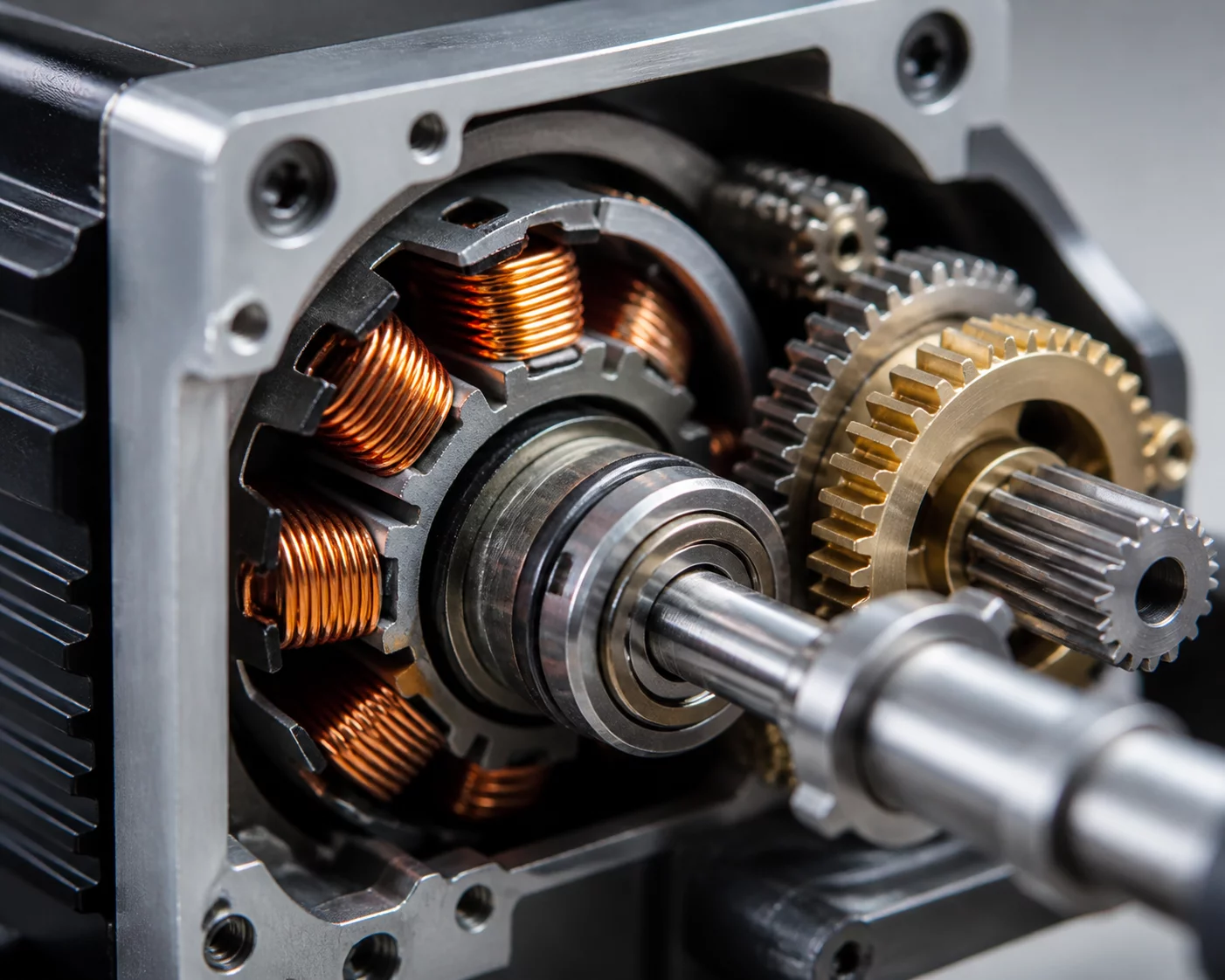
Continuous servo regulation provides seamless output correction without voltage steps, keeping output deviation below ±1% for sensitive instruments and demanding laboratory machinery.
Working Principles of Servo-Driven Voltage Stabilization
A servo-regulated voltage stabilizer utilizes an intelligent electronic sensing circuit paired with a reversible servomotor. The servomotor physically shifts a carbon brush along the exposed copper windings of a toroidal autotransformer. When incoming line voltage drops or surges, the control board detects the deviation in real time and commands the motor to reposition the contact point. This dynamic physical adjustment modifies the turns ratio smoothly, delivering a continuous and stepless output without harmonic distortion or waveform interruptions.
Eliminates discrete step-switching jumps, ensuring smooth voltage delivery for high-precision CNC units and medical diagnostics.
Pure sinusoidal output is maintained across the entire regulation range with negligible thermal or magnetic line loss.
Key Engineering Advantages over Stepped Relay Topologies
Unlike multi-tap relay stabilizers that switch in abrupt 10V to 15V increments, servo systems continuously adjust to exact nominal targets. This steady motion prevents flicker in high-intensity lighting systems and prevents micro-disruptions in sensitive microprocessor controls.
- High overload endurance capable of handling up to 200% surge currents during motor start-up cycles.
- Continuous linear output tracking without sparking, contact pitting, or electromagnetic switching noise.
- Integrated phase-independent regulation in three-phase models to correct severe line imbalances.